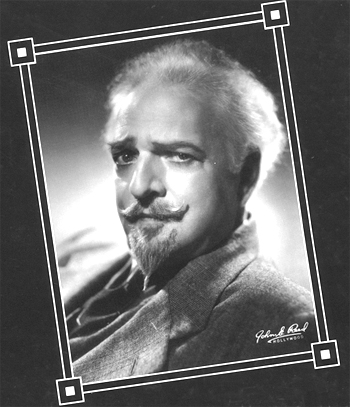
 Harry August Jansen was born in Copenhagen, Denmark and
settled in the United States. He traveled the world as a professional magician
under the name Dante the Magician. He emigrated to the U.S. as a small boy. He
started out in magic as an illusion builder. After becoming a performer and
touring as the "Great Jansen", he was chosen by Howard Thurston to
run the Thurston Number Two show, who gave him the name "Dante". He
built many of Thurston's illusions including the improved Horace Goldin
"Sawing a Woman in Half". "The Un-Sevilled Barber",
"Backstage", "The Magician's Rehearsal" and "Black and
White".
Harry August Jansen was born in Copenhagen, Denmark and
settled in the United States. He traveled the world as a professional magician
under the name Dante the Magician. He emigrated to the U.S. as a small boy. He
started out in magic as an illusion builder. After becoming a performer and
touring as the "Great Jansen", he was chosen by Howard Thurston to
run the Thurston Number Two show, who gave him the name "Dante". He
built many of Thurston's illusions including the improved Horace Goldin
"Sawing a Woman in Half". "The Un-Sevilled Barber",
"Backstage", "The Magician's Rehearsal" and "Black and
White".
Dante toured the world with his show
"Sim-Sala-Bim", including on Broadway. Sim Sala Bim was Dante's
trademark which he used as his magic words. He was often billed as "King
of Magicians".
He performed on TV shows such as "You Asked for
It" and in films.
Biography
Jansen came to the St. Paul, Minnesota at the age of 6 with
his family. At the age of 16 Jansen made his stage debut under Charles Wagner. He
then set off on a world tour for 5 years as the Great Jansen. In 1922, magician
Howard Thurston, realizing Jansen's talent and possible competition to him,
engaged Jansen to star in the #2 Thurston show. Thurston gave Jansen the stage
name of Dante. The name came from the original Dante, Oscar Eliason
(1869–1899), who had been killed in a tragic hunting accident in Australia
years earlier. In 1925, Dante the Magician Inc. came into being with Thurston
as co-owner. The 2nd unit Thurston show was built and co-produced by Jansen.
Dante was known throughout the world under the name Dante
the Magician, working in vaudeville, burlesque, legitimate theatre, films, and
in later years, television. Dante and his troupe, consisting of between 25
to 40 performers, made several global trips and appeared in many U.S. theaters.
His stage trademark was to utter three nonsense words, "Sim Sala Bim"
(taken from the lyrics of a Danish children's songduring his performances to
acknowledge applause. He can be seen using these words in the Swedish 1931
feature Dantes mysterier (Dante's Mysteries) and in the 1942 Laurel and Hardy
comedy A-Haunting We Will Go.
In 1940 he produced and starred the Broadway revue Sim Sala
Bim on the Morosco Theatre. With television, the public stayed home more often,
and the world of variety theatre suffered drastically. As a result, Dante
retired to his Southern California in the late 1940s.
Legacy
With Dante's death, what historically has been known as the
"Golden Age of Magic" came to an end. Gone were the variety theaters
of the world, and with it were the large traveling magic productions that had
thrilled and mystified millions for generations. In prior decades, the magical
lineage created by the American public had elevated magicians Alexander
Herrmann, Harry Kellar, Thurston and Dante to the position of the #1 magician
in the country.
 Shortly before Dante's death, he approached a young
magician, Lee Grabel, to be his successor in the lineage of great magicians.
Plans were underway at the time of Dante's death. However, because Dante died
before making a public announcement, some magical historians believe the
lineage ended with Dante. This magician has since chosen a Las Vegas headliner
magician, Lance Burton to be his successor, therefore carrying on the tradition
of the magical lineage to another generation. Despite this, its authenticity is
still questioned by some.
Shortly before Dante's death, he approached a young
magician, Lee Grabel, to be his successor in the lineage of great magicians.
Plans were underway at the time of Dante's death. However, because Dante died
before making a public announcement, some magical historians believe the
lineage ended with Dante. This magician has since chosen a Las Vegas headliner
magician, Lance Burton to be his successor, therefore carrying on the tradition
of the magical lineage to another generation. Despite this, its authenticity is
still questioned by some.
In 1991, magic historian Phil Temple published the
definitive biography of Dante the Magician, Dante - The Devil Himself, based
largely on Dante's personal records, and Temple's friendship with surviving
family members who had toured with the show decades earlier.
Years later, a memoir about life on the road with the Dante
show was written by Marion Trikosko, who spent two years with Dante as an
assistant. His book, Trouping with Dante, was published in 2006.
-Taken from MagicPedia and Wikipedia

No comments:
Post a Comment